

How to study for the SAT in under two days
The SAT is in two days, and the panic is starting to set in. Take a deep breath. You’re in the right place. While you can’t learn a year’s worth of material in 48 hours, you absolutely can learn a handful of powerful strategies to boost your score. This isn’t about becoming a math whiz overnight; it’s about turning that panic into a concrete plan to grab every possible point.
Forget about memorizing 500 vocabulary words. A successful SAT cramming strategy is less about knowing more and more about being smarter with what you already know. Think of this as test-prep triage: we aren’t performing major surgery on your academic skills. Instead, we’re focusing on stabilizing your score by learning how to master pacing, make educated guesses, and avoid the common traps that cost students easy points.
This last-minute plan focuses on the test’s patterns, which is how students see score improvements from short-term prep, not by cramming content. You’ll learn precisely where to focus your limited time for maximum impact—from knowing which math formulas are actually worth your time to understanding the single most important rule for the grammar section.
The Three Unbreakable Rules for Every SAT Question: Pace, Eliminate, and Guess
If you’re worried about running out of time, you’re not alone. The SAT is a race against the clock, but it’s a race you can control. Forget trying to know everything; instead, focus on mastering three universal rules that turn time pressure into an advantage. These strategies—Pacing, Process of Elimination, and No-Penalty Guessing—are your core toolkit for grabbing every possible point.
First, you need to manage your time with a strict personal rule: give yourself about one minute per question. If a problem seems too confusing or you can’t see a path to the answer within 60 seconds, circle it and move on. Don’t let one difficult question steal time you could use to answer three easier ones later. Like a quarterback throwing the ball away to avoid a sack, it’s a smart strategic move that keeps you in the game. You can always come back to it if you have time left.
For any question where you’re not 100% certain, immediately switch to the Process of Elimination (POE). This means crossing out answer choices you know are wrong. The SAT is a multiple-choice test, which means the right answer is always on the screen. Instead of searching for the correct one, focus on spotting the obviously incorrect ones. Eliminating even one wrong option increases your odds from 25% to 33%. If you can eliminate two, your guess is now a 50/50 shot.
This leads to the final, most important rule: never, ever leave a question blank. The SAT has no guessing penalty. A blank answer is a guaranteed zero points. A random guess gives you a 25% chance of being right. A guess after using POE gives you an even better shot. So, when time is up, fill in a letter—any letter—for every remaining question. Applying these rules is crucial, but it’s especially powerful at the beginning of each section, where your performance sets the stage for the questions to come.
How the Digital SAT’s First Module Can Make or Break Your Score
That final point about a section’s beginning is critical because the Digital SAT is “adaptive.” It adjusts to you. Think of it like a video game: do well on the first level, and you unlock a harder second level with more points available. The SAT works the same way. Your performance on the first group of questions in a section (called Module 1) determines whether you see an easier or a harder, higher-scoring second group (Module 2).
For your cramming strategy, this means you must prioritize accuracy on the first module. This is where your focus needs to be sharpest. Don’t rush. Use the Process of Elimination on every question you’re unsure about and fight for every correct answer you can find. Getting into that harder second module is your single best opportunity to access a higher score range, and this is the key to unlocking it.
A strong start is the most powerful way to increase your SAT score in just 24 hours. By concentrating your energy on that first set of questions, you give yourself the best possible strategic advantage.
High-Yield SAT Math: What to Focus on When You’re Out of Time
To make the most of your math review, target the highest-yield concepts. The SAT math section feels huge, but you can get the most points by focusing on just a few. If you only have a couple of hours, spend them reviewing linear equations (think y = mx + b), systems of equations, and percentages. These topics are guaranteed to appear and are the foundation for many other questions, making them the best use of your limited time for a quick score increase.
For the algebra you do encounter, you have a secret weapon: working backward. Instead of trying to solve for x, use a strategy called “Plugging In The Answers.” For any question with variables in the problem and plain numbers in the answer choices, simply test each choice. Plug it back into the equation until one makes the statement true. This simple trick can turn a difficult algebra problem that you’ve forgotten how to solve into a few seconds of basic arithmetic.
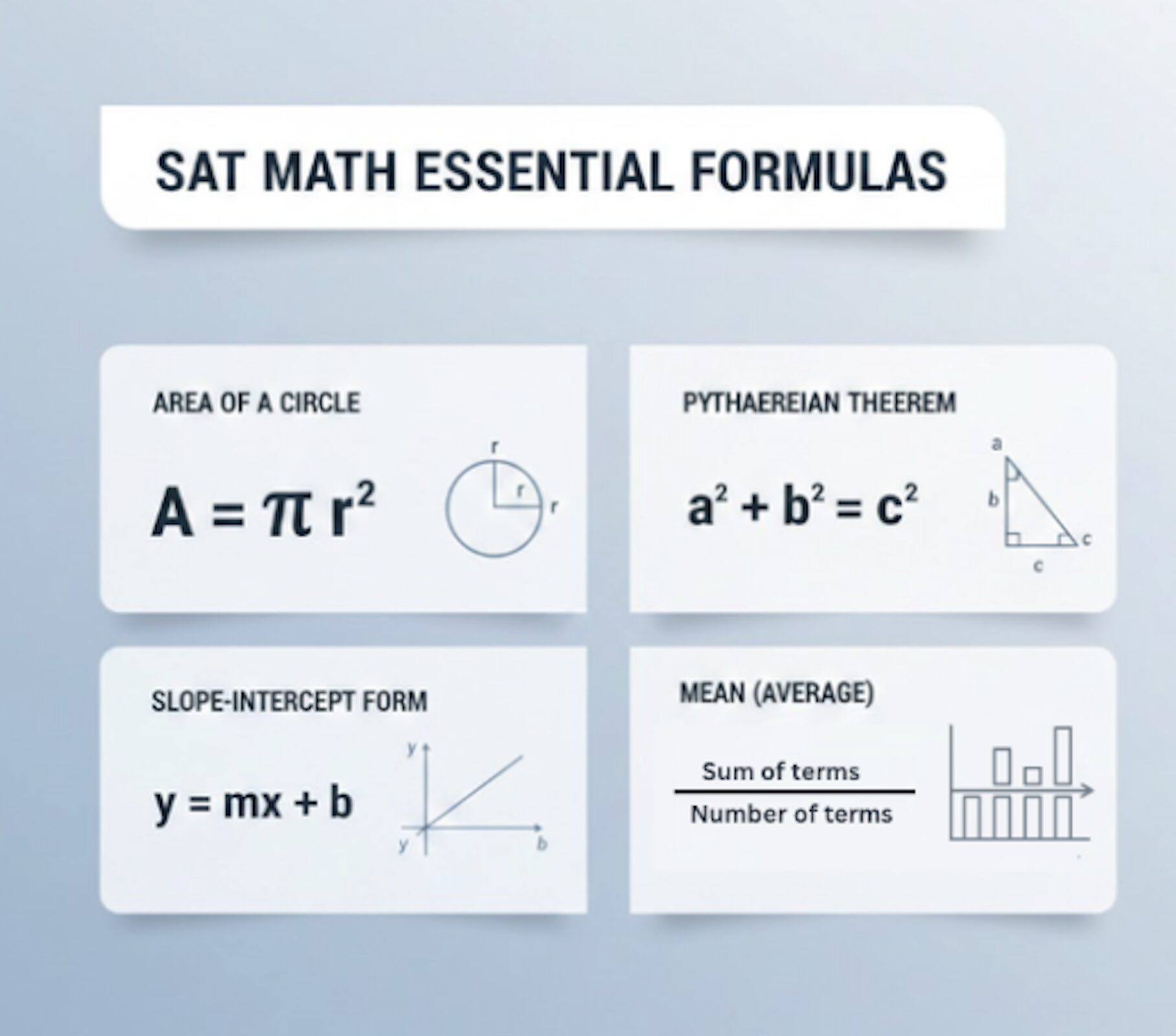
Finally, don’t try to memorize every formula. The test provides most of them, but having a few in your short-term memory will save you precious seconds. Focus only on these:
- Area of a circle: πr²
- Pythagorean theorem: a² + b² = c²
- Slope-intercept form: y = mx + b
- Mean (Average): Sum of terms / Number of terms
With these math priorities handled, the same triage principle applies to finding quick wins in the Reading and Writing section.
High-Yield SAT Grammar: The One Rule That Fixes Half the Section
When time is short, grammar should be about pattern recognition, not memorizing rules. If you only focus on one grammar concept in the final 48 hours, make it this: sentence boundaries.
Every complete sentence must answer one question: Who did what?
If both sides of a comma can answer that question, the comma is wrong.
The SAT’s favorite grammar trap is the comma splice—trying to connect two complete sentences with just a comma.
 The experiment was successful, the results surprised the researchers.
Once you spot this pattern, the fix is mechanical. You always have three correct options:
-
Use a period
-
Use a semicolon
-
Use a comma + FANBOYS (for, and, nor, but, or, yet, so)
 The experiment was successful; the results surprised the researchers.
This single rule can eliminate multiple wrong answers instantly. On test day, if you see an underlined comma, pause and check: Is there a full sentence on both sides? If yes, the comma is almost always wrong.
Use Your Error Log: The Fastest Way to Fix Repeat Mistakes
One of the most effective things you can do before test day is review your error log—a list of question types you’ve missed before. The more SAT practice tests you take, the more data you collect about your personal weak spots.
Don’t try to relearn everything. Instead, look for patterns. If you notice you often miss comma questions, pronouns, or linear equations, focus there. Even solving five targeted questions for your weakest category can lead to real score gains. Reviewing your past mistakes right before the exam helps prevent you from making the same mistake twice—and that’s one of the fastest ways to raise your score.

Your 48-Hour SAT Prep Guide: An Hour-by-Hour Schedule
Knowing the strategies is one thing; putting them into practice under pressure is another. A structured plan prevents you from wasting time or getting overwhelmed. This isn’t about learning everything; it’s about strategically focusing your energy. This two-day study schedule is designed for maximum return on your limited time. Your goal is to identify your easiest point-scoring opportunities and then rest your brain so you can seize them.
Here is your simple, effective last-minute SAT prep plan. Stick to it.
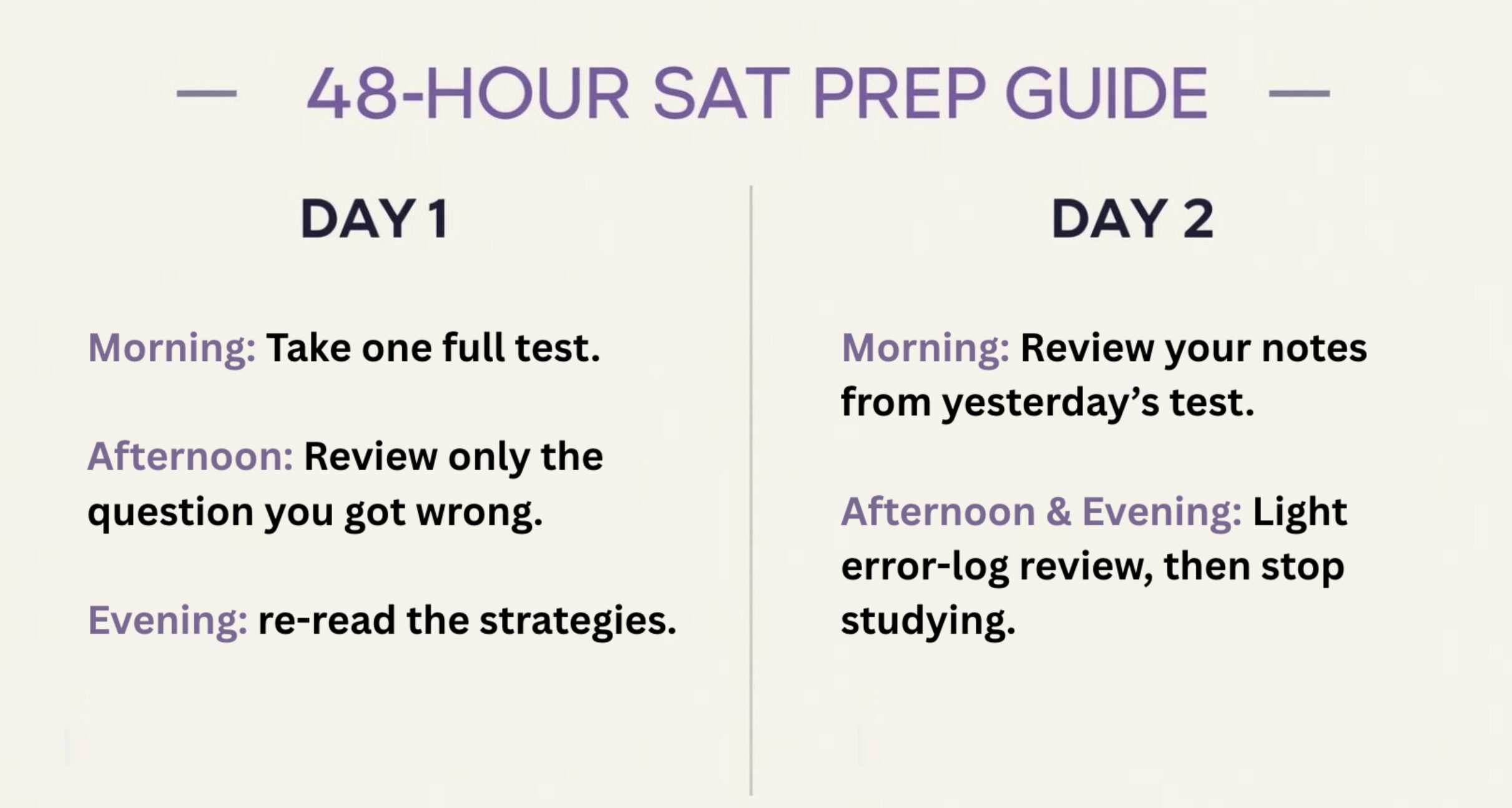
- DAY 1 (48 Hours Out)
- Morning (3 hrs): Take one full, timed digital practice test through the official Bluebook™ app or The SAT Crash Course practice tests, which include detailed performance reports to clearly show your strengths and weaknesses. The goal is not perfection, but to experience real SAT pacing and pinpoint where you can gain the most points.
- Afternoon (2 hrs): Review ONLY the questions you got wrong or guessed on. Don’t just look at the right answer. Ask yourself why you got it wrong. Was it a time issue? A specific grammar rule? A math formula you forgot?
- Evening (1 hr): Briefly re-read the strategies from this guide.
- DAY 2 (24 Hours Out)
- Morning (1 hr): Lightly review your notes from yesterday’s test, focusing on 5-10 key formulas or grammar rules that came up often.
- Afternoon & Evening: Do a light error-log review, then stop studying. Focus only on mistakes you’ve seen before. Once that’s done, rest. Sleep is part of your prep.
The most critical part of this schedule might be what you don’t do: cram all night. Your brain processes and consolidates information when you rest. Studying until midnight will only exhaust you, making you more likely to make careless errors on questions you actually know how to answer. Following this plan ensures you walk in rested, not fried. With your mind sharp and your plan set, the final piece of the puzzle is managing the test day itself.
The Test Day Checklist: How to Prevent Unforced Errors
Your mental state on test day is as critical as any formula. A forgotten ID or a sugar crash can cost you easy points—these are unforced errors you can completely avoid. Even if you didn’t study for the SAT in a traditional way, you can still gain an edge by controlling your environment. Use this simple checklist to make sure you walk in ready to perform at your peak.
Your Test Day Essentials:
- The Night Before: Pack your bag to prevent a morning panic. You’ll need your photo ID, a fully charged testing device with its charger, an approved calculator, a water bottle, and a snack.
- The Morning Of: Eat for sustained energy, not a quick rush. A balanced breakfast with protein and carbs (like eggs or oatmeal) will prevent a mid-test crash.
- During the Break: Use this time to physically reset. Stand up, stretch, and refuel with your snack and some water. Most importantly: do not discuss the test with anyone. It will only increase your anxiety.
This preparation isn’t about last-minute cramming; it’s about giving your brain the calm, focused environment it needs to access the knowledge you already have. You have a smart, realistic plan.
You Have the Plan—Now Go Execute It
You’ve done more in the last 48 hours than just study—you’ve transformed your approach. What was once a daunting wall of facts is now a navigable game with clear rules. You’ve replaced the panic of an approaching deadline with a focused, strategic plan, which is the most powerful tool you can bring into the testing room.
This isn’t about what you couldn’t learn; it’s about maximizing the knowledge you already have. Your success on test day will be determined by three simple, repeated actions: Pace yourself to get to the easy points, eliminate wrong answers to boost your odds, and always guess. A strategic approach is the core of any effective short-term prep.
Walk in on test day with the quiet confidence that comes from having a plan. Success in this situation isn’t defined by a perfect score, but by smart execution under pressure. You know the rules of the game and what to do if you didn’t study for every topic. Now, go play smart.
What’s Next?
Ready to get started on your digital SAT prep? Sign up for The SAT Crash Course that will help you build your concept foundation. The course recommends you just the right lessons and questions to tackle, helping you improve fast. Start now!